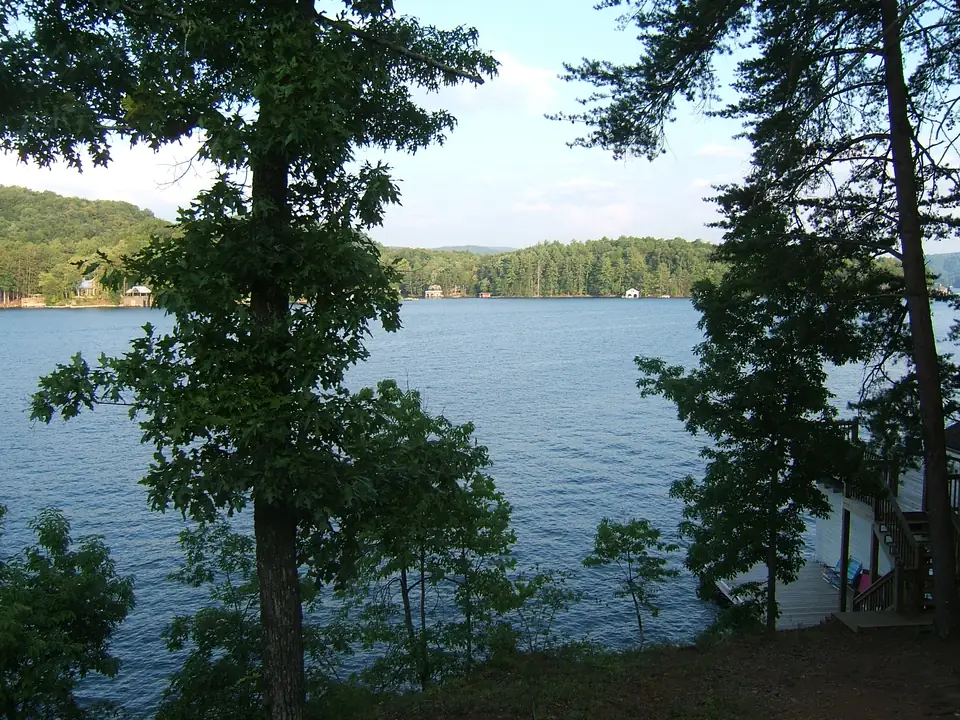
Lake Burton is younger than the town it drowned. Georgia Railway and Power, a predecessor of Georgia Power, began buying the town of Burton in 1917, finished Burton Dam on the Tallulah River in December 1919, and had a full lake by August 1920, according to the Rabun County Historical Society. The lake, in Rabun County, Georgia, kept the town’s name.
The town of Burton
The power company bought the town and much of the land around it starting in 1917. Sixty-five property owners sold. Their families moved to higher ground in the Tallulah valley, or to Tiger and Habersham County, the Historical Society writes. Then the water came up over the old town site, which now lies under about 65 feet of the lake.
You will hear more stories around the lake about what was left behind. Treat them as local lore: the documented record is the land purchase, the 65 owners who sold and the town’s place under the water.
- 1917
The town is bought
Georgia Railway and Power starts buying Burton and the land around it. Sixty-five property owners sell.
Source: Rabun County Historical Society, checked Oct 18, 2026
- 1919
The dam is finished
Burton Dam is completed in December, first to store water for the Tallulah Falls plant downstream.
Source: Rabun County Historical Society, checked Oct 18, 2026
- 1920
The lake is full
By August the water stands over the town, which the Historical Society says lies under about 65 feet of it.
Source: Rabun County Historical Society, checked Oct 18, 2026
- 1927
Burton makes power
The powerhouse at the foot of the dam comes online, the last of six plants built on the river since 1913.
Source: Rabun County Historical Society; NID, checked Oct 18, 2026
- 1950s
Rabun County is wired
The county whose rivers lit Atlanta is not fully electrified until the 1950s.
Source: Rabun County Historical Society, checked Oct 18, 2026
A storage dam first, 1917 to 1920
Burton Dam was not built to make electricity. The Historical Society says it was first built to store and regulate water for the Tallulah Falls power plant downstream.
The dam is concrete, 128 feet high and 983 feet long, with a 197-foot gated spillway and the powerhouse at its toe, as described in Georgia Power’s federal license filing. The National Inventory of Dams lists slightly different figures, 129 feet high and 1,043 feet long, and rated the dam’s condition Satisfactory in an assessment dated August 2026.
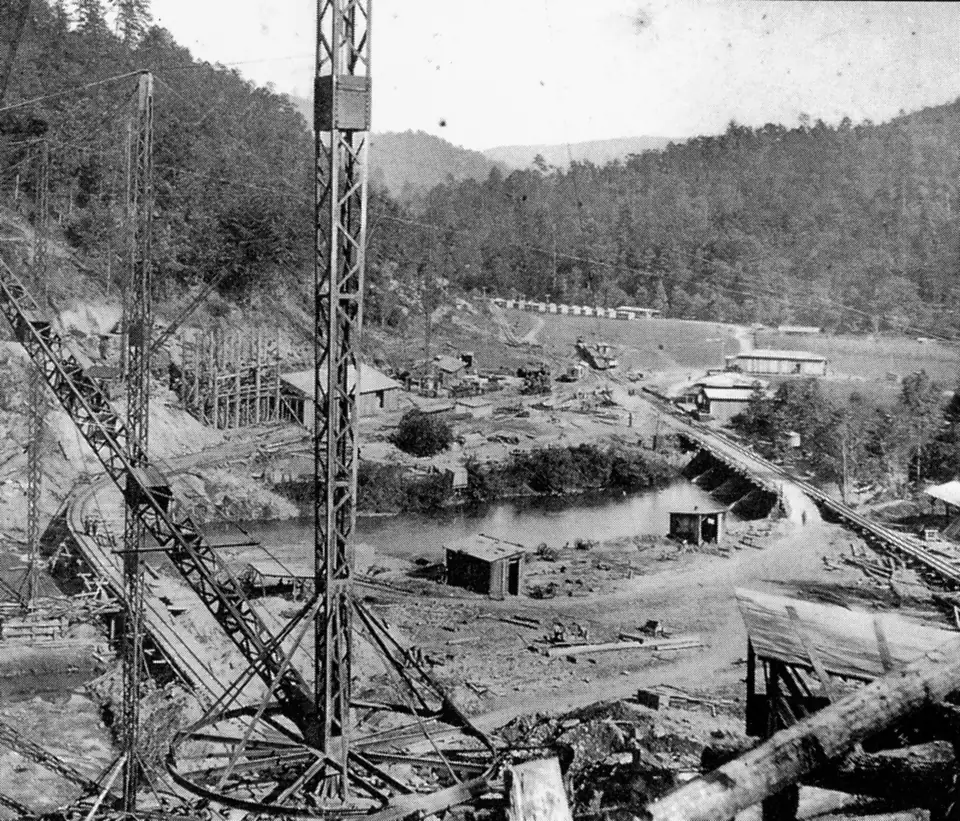
According to the Rabun County Historical Society, Burton Dam was finished in December 1919 and the lake was completely full by August 1920. (Rabun County Historical Society, checked Oct 18, 2026)
The powerhouse, 1927
Generators came seven years after the lake filled. The Burton powerhouse was not finished until 1927, with an original output of 6,120 kilowatts, the Historical Society says. That explains a date that confuses people: federal dam data gives 1927 as Burton’s year completed, which matches the powerhouse, not the 1919 dam.
Today Georgia Power lists the Burton plant at 8.1 MW, part of its North Georgia Hydro Group.
The Historical Society says the Burton powerhouse was not finished until 1927, with an original output of 6,120 kilowatts. The National Inventory of Dams gives 1927 as the year completed. (Rabun County Historical Society; NID, checked Oct 18, 2026)
Six dams and a 1,200-foot drop
Burton was one piece of a larger plan. Six dams and power plants went up on the Tallulah and Tugalo rivers between 1913 and 1927, along a 26-mile stretch of river that drops 1,200 feet, and all of their power went to Atlanta. Rabun County itself was not fully electrified until the 1950s.
The six still operate together as Georgia Power’s North Georgia Project, FERC Project No. 2354. Burton, Nacoochee, Mathis-Terrora and Tallulah Falls are on the Tallulah River, and Tugalo and Yonah are on the Tugalo River. Their lakes, from the top down:
- Lake Burton (Burton Dam), the uppermost
- Seed Lake (Nacoochee Dam)
- Lake Rabun (Mathis Dam)
- Tallulah Falls Lake
- Lake Tugalo
- Lake Yonah
Georgia Power still posts all six in one table, which is how our lake levels page reads Burton’s level.
Life on the new lake
Within a few years the reservoir had become a fishing lake.

Some of the lake’s best-known places trace back to the dam. LaPrade’s says its site first housed the men who built the dam, and later became a fishing retreat with a shared dining room. At the north end, Anchorage Boat Dock, at the head of Timpson Creek, was built by Ned and Ruth Stockton in 1959; the Poole family bought it in 1967 and still runs it, according to Anchorage.
Lake residents organized in 1968, when the Lake Burton Civic Association was founded. It now reports more than 2,000 members. The Lake Burton Fun Run, a two-mile run and walk, started in 1984 with 85 participants and starts at the Moccasin Creek State Park pavilion.
The dam today: new spillway gates, no drawdown
Burton Dam is getting new spillway gates. In a 2025 filing summarized in the Federal Register, Georgia Power asked FERC to replace the dam’s bottom-hinged spillway gates with an Obermeyer gate system and build a control building. The work is done behind a bulkhead, so Georgia Power says no drawdown is required. It was expected to begin in 2026 and take 18 to 24 months. Georgia Power says the new gates will keep the dam operating during high flows and let operators control the lake level better.
Separately, the Lake Burton Civic Association reported that the lake would stay at its normal level, which it gives as 1,865 feet, through the winter of 2025-2026 while the dam’s generating facility was modernized.
Georgia Power has asked FERC to replace Burton Dam's bottom-hinged spillway gates with an Obermeyer gate system and build a control building. The work is done behind a bulkhead, so Georgia Power says no drawdown is required. It was expected to begin in 2026 and take 18 to 24 months. (Federal Register (FERC, 2025), checked Oct 18, 2026)
Seeing the dam
Burton Dam Road crosses the south end of the lake at the dam. Georgia Power warns that the areas below its dams are hazardous when water is released, so keep clear of the river below the dam. Find the dam and the other sites on our Lake Burton map, and read the longer story of the town under the lake.
Dam
Burton Dam and powerhouse (Georgia Power)
The concrete dam at the south end of the lake, 128 ft high and 983 ft long in Georgia Power's license filing, with an 8.1 MW powerhouse at its toe. Finished in 1919 as a storage dam; the powerhouse followed in 1927. Areas below the dam are hazardous when water is released.
- Burton Dam Road, Rabun County, Georgia
Source: Federal Register, checked Oct 18, 2026
Questions people ask
When was Lake Burton built?
Burton Dam was finished in December 1919 and the lake was completely full by August 1920, according to the Rabun County Historical Society. The powerhouse was finished in 1927, which is the year federal dam data lists as completed.
Source: Rabun County Historical Society, checked Oct 18, 2026
Is there a town under Lake Burton?
Yes. Georgia Railway and Power began buying the town of Burton in 1917, and 65 property owners sold. The lake took the town's name, and the Historical Society says the town lies under about 65 feet of water.
Source: Rabun County Historical Society, checked Oct 18, 2026
Why was Burton Dam built?
It was first built to store and regulate water for the Tallulah Falls power plant downstream, not to make power itself. It was one of six dams built on the Tallulah and Tugalo rivers between 1913 and 1927 to send power to Atlanta.
Source: Rabun County Historical Society, checked Oct 18, 2026
How much electricity does Burton Dam make?
Georgia Power lists the Burton plant at 8.1 MW, part of its North Georgia Hydro Group. The Rabun County Historical Society says the original 1927 powerhouse produced 6,120 kilowatts.
Source: Georgia Power, checked Oct 18, 2026
How big is Burton Dam?
Georgia Power's federal license filing describes Burton Dam as 128 feet high and 983 feet long, with a 197-foot gated spillway and the powerhouse at its toe. The National Inventory of Dams lists it at 129 feet high and 1,043 feet long.
Source: Federal Register (FERC, 1994), checked Oct 18, 2026
Will the Burton Dam spillway project lower the lake?
No drawdown is required, Georgia Power told FERC, because the new spillway gates are installed behind a bulkhead. The project was expected to start in 2026 and take 18 to 24 months.
Source: Federal Register (FERC, 2025), checked Oct 18, 2026